
Overview
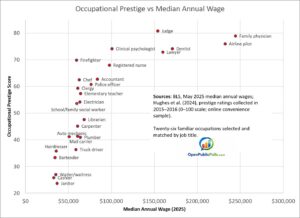
This analysis examined the relationship between occupational prestige and median annual income for 26 familiar occupations in the United States. The occupations were selected to represent a broad range of professional, skilled, service, and manual occupations rather than to constitute a representative sample of all occupations.
Occupational prestige scores were drawn from the contemporary prestige ratings developed by Hughes et al. (2024). Their study produced prestige ratings for more than 1,000 occupations in the O*NET system and provided evidence for the reliability and validity of the ratings. Median annual wage data were obtained from the U.S. Bureau of Labor Statistics Occupational Employment and Wage Statistics program for May 2025. The OEWS program reports employment and wage estimates for approximately 830 occupations nationwide.
Linear Association
There was a strong positive linear relationship between occupational prestige and median annual income, r = .77. The corresponding linear regression model accounted for 59.6% of the variance in occupational prestige, R² = .596, F(1, 24) = 35.35, p < .001.
Thus, higher-paying occupations generally received higher prestige ratings. Lower-paying service occupations tended to have relatively low prestige scores, whereas highly paid professional occupations tended to have substantially higher prestige.
The scatterplot, however, suggested that the association was not entirely linear. Prestige appeared to increase particularly rapidly across the lower and middle portions of the income distribution and then level off among higher-paying occupations.
Nonlinear Association
Several nonlinear models were therefore compared with the linear model. The logarithmic model accounted for 76.7% of the variance in prestige, the quadratic model accounted for 79.8%, the inverse model accounted for 81.7%, the cubic model accounted for 83.4%, and the power model accounted for 70.6%.
Although the cubic model produced the highest unadjusted R², it required additional parameters and exhibited a downturn in predicted prestige at the upper end of the income range. Given the relatively small sample of 26 occupations, this more complex form may reflect overfitting rather than a substantively meaningful pattern.
The inverse model provided the strongest parsimonious representation of the relationship. The model was statistically significant, R² = .817, F(1, 24) = 107.13, p < .001, and took the form:
Prestige = 87 – ($2,077,862)/(Median Annual Wage)
The inverse model therefore accounted for approximately 82% of the variation in occupational prestige, compared with about 60% for the conventional linear model.
Interpretation
The findings indicate that occupational income and prestige are very strongly related, but the association is distinctly nonlinear. Increases in income are associated with particularly large increases in occupational prestige at lower income levels. As income rises, however, additional increases in pay are associated with progressively smaller increases in prestige.
This pattern suggests a form of diminishing returns of income to occupational prestige. Moving from a relatively low-paying occupation to a moderately or highly paid occupation is associated with a substantial increase in perceived occupational status. In contrast, differences in income among already highly paid occupations correspond to relatively modest differences in prestige.
The inverse model approaches an asymptote of approximately 87 prestige points, suggesting that extremely high occupational earnings would not necessarily produce proportionately higher social prestige. This is consistent with the idea that prestige reflects more than economic compensation alone. Educational requirements, professional authority, perceived social contribution, occupational risk, autonomy, and cultural attitudes toward different types of work may also contribute to the status accorded to an occupation.
The magnitude of the nonlinear association is noteworthy. Whereas the Pearson correlation of r = .77 indicates that approximately 60% of the variance in prestige is associated with income under a linear specification, allowing for the curvilinear relationship increases explained variance to approximately 82%. Thus, median occupational income appears to be an exceptionally strong correlate of occupational prestige within this set of occupations.
Limitations
Several qualifications should be considered. First, the 26 occupations were purposively selected to provide recognizable examples spanning the income and prestige distributions. They therefore do not constitute a random or representative sample of U.S. occupations, and the reported R² values should not be interpreted as population estimates for all occupations.
Second, the occupational prestige ratings used by Hughes et al. (2024) were initially obtained from an online convenience sample, although the authors reported high reliability and provided additional convergent and construct-validity evidence across subsequent studies.
Third, the analyses are correlational. They do not demonstrate that higher wages cause greater occupational prestige. Prestige could influence compensation, compensation could influence prestige, or both could arise partly from common factors such as education, occupational complexity, professional authority, and scarcity of specialized skills.
Finally, because the nonlinear models were evaluated using the same relatively small sample in which they were developed, replication with a substantially larger and more representative set of occupations would provide a stronger test of whether the inverse functional form generalizes.
Conclusion
Occupational prestige was strongly associated with median annual income. The conventional Pearson correlation was r = .77, and a linear regression accounted for 59.6% of the variance in prestige. The relationship was substantially better represented by a nonlinear inverse function, which accounted for 81.7% of the variance. The pattern suggests that income is strongly associated with occupational status, particularly across lower and middle income levels, but that the prestige associated with additional income diminishes among highly paid occupations.
The results therefore support a simple but important conclusion: income is closely related to occupational prestige, but the relationship is one of diminishing returns rather than a constant linear increase.
References
Hughes, B. T., Srivastava, S., Leszko, M., & Condon, D. M. (2024). Occupational prestige: The status component of socioeconomic status. Collabra: Psychology, 10(1), Article 92882. https://doi.org/10.1525/collabra.92882
U.S. Bureau of Labor Statistics. (2026). Occupational employment and wages—May 2025. U.S. Department of Labor. https://www.bls.gov/oes/