
How would you explain the results? Does where you live affect your relationship satisfaction?
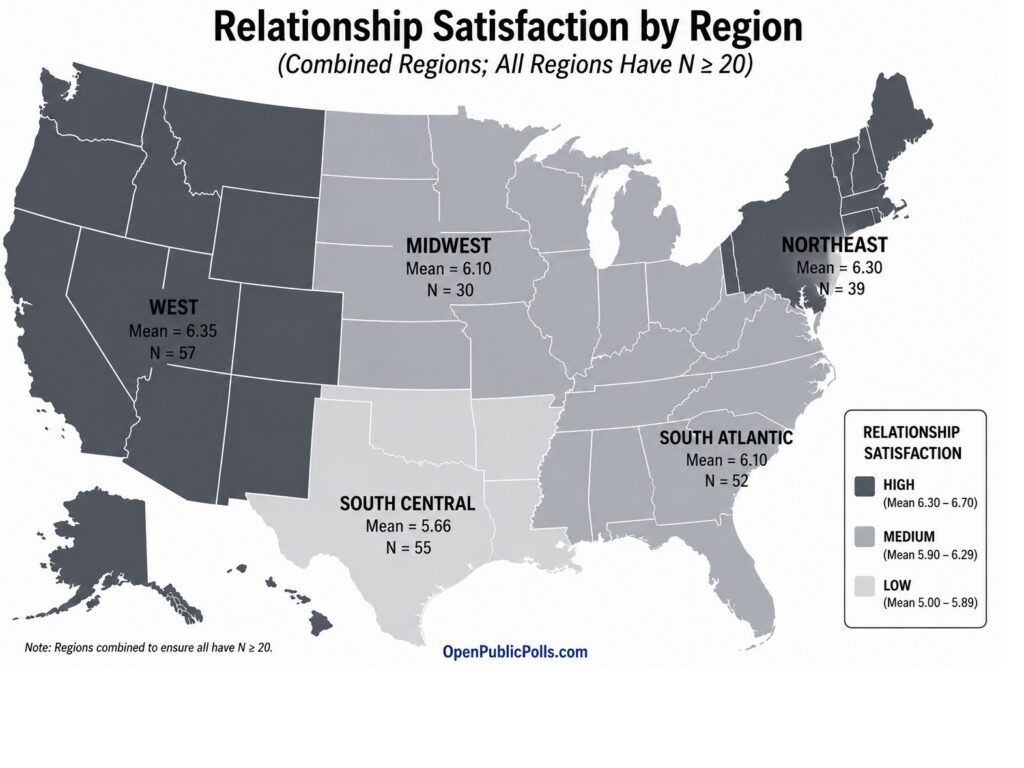
Relationship Satisfaction by Region in the United States
Jonathan Rich, PhD
Overview
OpenPublicPolls.com conducted an online survey examining relationship satisfaction across major regions of the United States. Participants were adults (18+) who reported being married or in a long-term committed relationship. Relationship satisfaction was rated on a 7-point scale ranging from 1 (Very Dissatisfied) to 7 (Very Satisfied).
To improve statistical stability and avoid very small regional samples, U.S. Census regions were consolidated into five broader geographic groupings. Each combined region included at least 20 participants.
The final sample size was N = 233. The sample was 65% female, 35% male, age range 20 to 61 with a mean of 30.4 years. Median relationship length was 6 to 10 years; 98% had at least a college education.
Regional Differences in Relationship Satisfaction
The analysis revealed statistically significant differences in relationship satisfaction across the five regions:
This finding suggests that average relationship satisfaction differed meaningfully by region within this sample.
Mean Relationship Satisfaction by Region
Region | Mean Satisfaction | N |
West | 6.35 | 57 |
Northeast | 6.30 | 39 |
Midwest | 6.10 | 30 |
South Atlantic | 6.10 | 52 |
South Central | 5.66 | 55 |
Interpretation of the Findings
Participants in the West and Northeast reported the highest average relationship satisfaction scores, both exceeding 6.3 on the 7-point scale. The Midwest and South Atlantic regions showed moderately high satisfaction levels, with identical means of 6.10.
The South Central region reported the lowest average relationship satisfaction score (5.66), noticeably lower than the other regions in the study.
Although the overall pattern was statistically significant, caution is warranted in interpreting the results. The survey relied on a convenience sample collected online, meaning participants were not randomly selected from the U.S. population. As a result, the findings may not generalize to all Americans.
Additionally, regional averages can reflect many overlapping influences, including demographic composition, economic conditions, cultural attitudes, religious traditions, urban versus rural living patterns, and sampling differences unique to online recruitment.
Limitations
Several limitations should be considered:
- The sample was not nationally representative.
- Participants self-selected into the survey.
- Regional categories were consolidated to ensure adequate sample sizes.
- The study measured self-reported satisfaction at a single point in time.
- Correlational regional differences do not establish causation.
Conclusion
Despite its limitations, the study identified clear regional variation in relationship satisfaction within this online sample. Participants from the West and Northeast tended to report the highest satisfaction, while those from the South Central region reported comparatively lower levels.
The findings highlight how social and geographic context may relate to relationship experiences and demonstrate how online polling can generate interesting exploratory insights into interpersonal well-being.
Source: OpenPublicPolls.com