
Obsolete Skills Data File
Abstract
Many everyday skills that were once commonplace have become increasingly uncommon because of technological change. The present study examined the prevalence of ten arguably obsolete skills and explored whether age, gender, educational attainment, and country of residence were associated with possessing those skills. A convenience sample of 138 adults was recruited through the Reddit r/SampleSize forum. Participants indicated whether they could perform each of ten obsolete skills and completed a brief demographic questionnaire. The most common skills were writing a letter in cursive (87%) and reading a paper map (85%), whereas Morse code (4%), shorthand (9%), and slide rule use (15%) were rare. Age demonstrated the strongest and most consistent relationships with obsolete skills. Older participants were significantly more likely to report knowing how to develop photographs, program in BASIC, and balance a checkbook. Findings suggest that although some traditional skills remain nearly universal, others are rapidly disappearing and are increasingly concentrated among older adults.
________________________________________
Introduction
Technological advances have transformed many activities that were once routine. Skills such as navigating with paper maps, balancing a checkbook, developing photographs, or programming in BASIC have largely been replaced by digital alternatives. While these skills are often regarded as obsolete, little information exists regarding how many people still possess them or whether these abilities differ across demographic groups.
The present study surveyed adults regarding ten traditional skills that have declined in everyday use. Attention was given to age, as many of these skills were more common in earlier decades.
________________________________________
Method
Participants
Participants consisted of 138 adults recruited through a convenience sample posted on the Reddit r/SampleSize forum. The sample was relatively young, with 65.2% between the ages of 18 and 34 years, 22.5% between 35 and 44 years, and 12.3% aged 45 years or older. Participants resided in the United States (55.8%), Europe (29.0%), Asia (1.4%), and other regions (13.8%).
The sample was well educated. Nearly two-thirds (64.5%) had completed at least a bachelor’s degree, including 28.3% with master’s degrees and 6.5% with doctorates. Participants identified as female (47.8%), male (42.0%), or another gender identity (10.1%).
Measures
Participants indicated whether they could perform each of ten arguably obsolete skills:
• Basic automobile repair
• Morse code
• Developing photographs
• Reading a paper map
• Programming in BASIC
• Writing shorthand
• Driving a manual transmission
• Writing a letter in cursive
• Balancing a checkbook
• Using a slide rule
Demographic variables included age, gender, educational attainment, and country of residence.
Statistical Analysis
Pearson correlations were computed between each skill and age, gender (male versus all other gender identities), educational attainment, and U.S. residence. Because numerous correlations were examined, statistical significance was evaluated using a conservative alpha level of p < .001.
________________________________________
Results
Overall, the most common obsolete skills were writing a letter in cursive (87.0%) and reading a paper map (84.8%). Approximately half of respondents reported being able to drive a manual transmission (47.1%) and balance a checkbook (46.4%). Less common were basic automobile repair (29.0%), developing photographs (18.8%), programming in BASIC (17.4%), using a slide rule (14.5%), writing shorthand (9.4%), and Morse code (4.3%).
Age was the demographic variable most strongly associated with obsolete skills. Older participants were significantly more likely to report knowing how to develop photographs (r = .382, p < .001), program in BASIC (r = .389, p < .001), and balance a checkbook (r = .409, p < .001). Figure 1 illustrates the pronounced age gradient for these three skills. Although respondents younger than 35 rarely reported these abilities, the majority of participants aged 45 years and older indicated possessing them.
Gender, education, and country of residence exhibited comparatively weaker relationships. Men were more likely to report knowing automobile repair, BASIC programming, and driving a manual transmission, although only the latter approached the conservative significance criterion. Participants residing in the United States were less likely to know how to drive a manual transmission but somewhat more likely to balance a checkbook. Educational attainment showed no meaningful associations with obsolete skills after correction for multiple comparisons.
Figure 1
Age-Related Differences in Selected Obsolete Skills
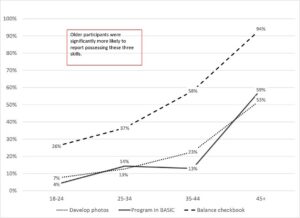
Figure Note. Percentages represent the proportion of participants within each age category reporting each skill. The final age category combines respondents aged 45 years and older because of small sample sizes in the oldest age groups (n = 17).
________________________________________
Discussion
The results demonstrate that many obsolete skills remain surprisingly common. Nearly nine in ten participants reported being able to write a letter in cursive and read a paper map, suggesting that these skills continue to be retained despite declining everyday use.
In contrast, skills associated with superseded technologies—particularly developing photographs, programming in BASIC, and balancing a checkbook—were strongly associated with age. These findings likely reflect historical changes in technology and education. Older participants acquired these skills when they were commonly taught or routinely required, whereas younger adults have had fewer opportunities or reasons to learn them.
Interestingly, the sample was predominantly young, with nearly two-thirds of participants under age 35. Despite this youthful sample, traditional skills such as cursive writing and map reading remained highly prevalent. This suggests that these abilities may persist long after their practical necessity has diminished.
Several limitations should be acknowledged. Participants were recruited through Reddit and therefore constitute a convenience sample that is not representative of the general population. The sample was relatively well educated and included a substantial proportion of European respondents. In addition, all measures were based on self-report rather than direct assessment of skill proficiency.
Nevertheless, the findings provide an informative snapshot of which traditional skills continue to survive in the digital era. Future research using nationally representative samples could examine whether these patterns generalize to broader populations and how rapidly these skills continue to decline over time.