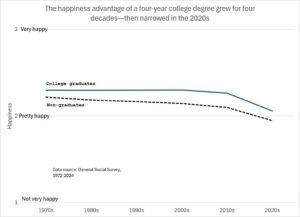
Has the relationship between educational attainment and happiness changed over time? Using data from the General Social Survey (GSS), I examined self-reported happiness among U.S. adults aged 25 years and older from 1972 through 2024.
Happiness was measured using the GSS three-category item (“not too happy,” “pretty happy,” and “very happy”), recoded so that higher values indicate greater happiness. Respondents were grouped according to whether they had completed a four-year college degree.
The analysis included 63,114 adults, including 16,331 four-year college graduates and 46,783 adults without a four-year degree. Sample sizes by decade ranged from 9,114 respondents in the 1970s to 12,391 in the 1980s.
Across all decades, adults with a four-year college degree reported significantly greater happiness than those without a degree, F(1, 63,102) = 426.58, p < .001. Happiness also changed significantly over time, F(5, 63,102) = 188.75, p < .001.
Most importantly, the relationship between education and happiness varied by decade, producing a significant Education × Decade interaction, F(5, 63,102) = 3.93, p = .001.
From the 1970s through the 2010s, the happiness advantage associated with a four-year college degree increased steadily. The average difference between graduates and non-graduates rose from 0.08 points in the 1970s to 0.17 points in the 2010s on the three-point happiness scale. A follow-up regression (excluding the 2020s) confirmed a significant positive linear increase in this education gap.
That long-term pattern changed in the 2020s. Happiness declined substantially in both educational groups, and the difference between them narrowed. Among adults without a four-year degree, mean happiness fell from 2.10 in the 2010s to 1.94 in the 2020s. Among four-year college graduates, it declined from 2.26 to 2.06 over the same period.
The GSS data identify this change in pattern but do not explain its cause. The 2020s encompass the COVID-19 pandemic and other major economic and social disruptions that may have affected well-being across educational groups.
Overall, these findings suggest that the association between a four-year college degree and happiness strengthened gradually for approximately four decades before partially reversing during the 2020s.
Figure note
Source: General Social Survey (GSS), 1972–2024. Analyses were limited to adults aged 25 years and older. Total N = 63,114 (46,783 without a four-year degree; 16,331 with a four-year degree).