
Using data from the General Social Survey (GSS), I examined the average occupational prestige scores of employed White and Black respondents from 1972 through 2024.
Occupational prestige is a long-established measure of the social standing associated with occupations. Higher scores indicate occupations that Americans generally regard as having greater prestige.
Findings
- White respondents consistently reported occupations with higher average prestige scores than Black respondents throughout the study period.
- Occupational prestige increased slightly over time for both groups.
- Although the average difference remained statistically significant, the trends over time were remarkably similar. There was no evidence that the racial difference systematically widened or narrowed across the five decades studied.
- The linear increase in prestige over time was statistically significant but very small (r = .053), indicating only a modest upward trend.
Methods
- Dataset: General Social Survey (1972–2024)
- Outcome: PRESTG10 occupational prestige score (2010 scale)
- White respondents: 25,089
- Black respondents: 4,388
- Total sample: 29,477
Annual sample sizes ranged from:
- White: 427–1,503 respondents
- Black: 36–285 respondents
The smaller Black samples likely explain the greater year-to-year fluctuation visible in that line.
Statistical Results
A two-way ANOVA found significant main effects for both race and survey year (both p < .001), but no race × year interaction (p = .737), indicating that both groups followed similar long-term trends despite maintaining different average prestige levels.
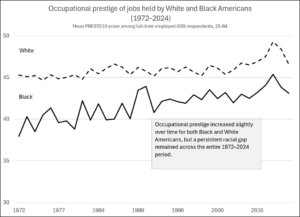
Source: General Social Survey (NORC), occupational prestige (PRESTG10). Means are based on respondents with valid occupational prestige scores, employed full-time, age 25-64.