
The percentage of Americans who report having had opposite-sex intercourse rises sharply during the late teenage years and then levels off during adulthood. Men report earlier experience during adolescence, but the difference between men and women largely disappears by the early twenties.
Among 15-year-olds, approximately 16% of males and 7% of females reported having had intercourse. The difference was particularly pronounced at age 17, when about 42% of males reported having had intercourse, compared with 22% of females. By age 18, however, the estimates were much closer: approximately 44% for males and 39% for females.
Most respondents of both sexes reported having had intercourse by age 20—approximately 60% of males and 58% of females. The percentages continued to increase rapidly during the early twenties. At age 25, about 81% of males and 83% of females reported having had intercourse. From that point onward, there was no consistent difference between the sexes.
By the early thirties, approximately nine out of ten respondents reported having had opposite-sex intercourse. Among respondents in their forties, estimates generally ranged from about 92% to 99%. The small fluctuations at older ages should not be interpreted as meaningful changes. Each point represents a different group of respondents, and the irregularities probably reflect sampling variability.
The large apparent sex difference during adolescence is the most notable finding. Several explanations are possible, including differences in reporting, differences in the ages of male and female partners, and sampling variability. Because these are descriptive, cross-sectional data, the results cannot determine why the difference occurs or whether every age-specific difference is statistically significant.
These results come from the CDC’s 2022–2023 National Survey of Family Growth. The percentages were weighted to represent the U.S. household population, while the actual unweighted sample consisted of 5,586 females and 4,371 males. Respondents were interviewed at one point in time; consequently, the graph compares different age groups rather than following the same people as they grow older.
The NSFG variable used here has a specific definition. For females, it indicates whether the respondent had ever had vaginal intercourse with a male; for males, it indicates whether the respondent had ever had vaginal intercourse with a female. It therefore does not include every form of sexual activity or sexual experience with a same-sex partner.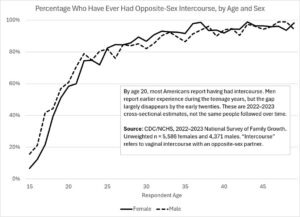
Source: CDC/NCHS, 2022–2023 National Survey of Family Growth. Weighted estimates; unweighted sample sizes: 5,586 females and 4,371 males.