
Satisfaction With Physical Intimacy and Relationship Satisfaction: The Role of Gender
Jonathan Rich, PhD
jrich@psychologicaltesting.com
Join the Discussion in the Forum
Abstract
This exploratory study examined the relationship between satisfaction with physical intimacy and overall relationship satisfaction among adults in committed relationships, with gender included as a moderating variable. Participants (N = 224) were recruited online using a convenience sampling method and included adults age 18 and older who were married or involved in a long-term committed relationship. Relationship satisfaction was rated on a 7-point scale ranging from 1 (Very dissatisfied) to 7 (Very satisfied). Satisfaction with physical intimacy was measured using agreement with the statement, “I am satisfied by the physical intimacy in our relationship,” rated from 1 (Strongly disagree) to 4 (Strongly agree). A two-way analysis of variance (ANOVA) revealed significant main effects for gender and intimacy satisfaction, as well as a significant interaction between the variables. The relationship between intimacy satisfaction and overall relationship satisfaction was substantially stronger for men (r = .44, p < .001) than for women (r = .16, ns). Results suggest that satisfaction with physical intimacy may be more strongly associated with overall relationship satisfaction among men than among women in this sample.
Introduction
Relationship satisfaction is influenced by a wide range of interpersonal, emotional, and behavioral factors. One area that has received considerable attention in relationship research is the role of physical intimacy and sexual satisfaction in overall relationship quality. Although physical intimacy is often viewed as an important component of healthy relationships for both men and women, prior research suggests that the strength and nature of this association may differ by gender.
The present exploratory study examined the relationship between satisfaction with physical intimacy and overall relationship satisfaction in a sample of adults involved in committed relationships. Particular attention was given to whether gender moderated this relationship.
Method
Participants
Participants consisted of 224 adults recruited online through a convenience sampling method. Eligibility criteria required participants to be at least 18 years old and either married or involved in a long-term committed relationship. The sample included 73 men and 151 women. Mean age was 30.6 years, with ages ranging from 20 to 61. Approximately 10.3% of participants reported being in a same-sex relationship.
Measures
Relationship Satisfaction
Participants rated their overall relationship satisfaction on a 7-point Likert-type scale:
1 = Very dissatisfied
7 = Very satisfied
Satisfaction With Physical Intimacy
Participants also rated agreement with the statement:
“I am satisfied by the physical intimacy in our relationship.”
Responses were made on a 4-point Likert-type scale:
1 = Strongly disagree
4 = Strongly agree
Procedure
Participants completed an online survey that included demographic questions, the relationship satisfaction item, and the physical intimacy satisfaction item.
Statistical Analysis
A two-way analysis of variance (ANOVA) was conducted examining relationship satisfaction as a function of gender and level of satisfaction with physical intimacy. Correlations between physical intimacy satisfaction and relationship satisfaction were also calculated separately for men and women.
Results
The ANOVA revealed statistically significant main effects for both gender and satisfaction with physical intimacy, as well as a statistically significant interaction between the two variables. The interaction indicated that the relationship between physical intimacy satisfaction and overall relationship satisfaction differed for men and women.
For men, satisfaction with physical intimacy was moderately associated with overall relationship satisfaction:
- r = .44, p < .001
For women, the relationship was substantially weaker and not statistically significant:
- r = .16, ns
Figure 1 illustrates the interaction between gender and satisfaction with physical intimacy.
Among men, relationship satisfaction increased sharply as satisfaction with physical intimacy increased. Men who disagreed that they were satisfied with physical intimacy reported notably lower relationship satisfaction (M = 5.1), while men who strongly agreed reported much higher satisfaction (M = 6.5).
Among women, relationship satisfaction remained relatively high across all levels of intimacy satisfaction. Women who disagreed still reported moderately high relationship satisfaction (M = 6.3), and scores changed comparatively little across agreement levels.
These findings suggest that satisfaction with physical intimacy was more strongly tied to overall relationship satisfaction for men than for women in this sample.
Figure 1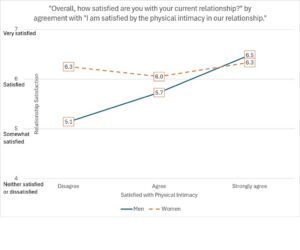
Discussion
The present findings suggest important gender differences in the relationship between physical intimacy satisfaction and overall relationship satisfaction. While both men and women generally reported relatively high relationship satisfaction, satisfaction with physical intimacy appeared to play a substantially larger role in men’s evaluations of their relationships.
For men, lower satisfaction with physical intimacy was associated with noticeably lower overall relationship satisfaction. In contrast, women maintained relatively high levels of relationship satisfaction even when reporting lower satisfaction with physical intimacy.
One possible interpretation is that women may place relatively greater emphasis on additional dimensions of relationships, such as emotional connection, communication, companionship, stability, or shared responsibilities, whereas men in this sample may have weighted physical intimacy more heavily in their global evaluations of relationship quality. However, the present study was exploratory and was not designed to determine causal explanations.
An important contextual observation is that relationship satisfaction remained generally high throughout the sample. Even groups reporting lower satisfaction with physical intimacy still averaged above the midpoint of the relationship satisfaction scale.
Limitations
Several important limitations should be noted:
- The sample was a convenience sample recruited online rather than a probability sample.
- The sample size for men was substantially smaller than the sample size for women.
- Self-report data may be influenced by social desirability or response bias.
- The cross-sectional design prevents causal conclusions.
- Additional relationship variables, including relationship duration, emotional intimacy, conflict frequency, income, and educational level, were not controlled.
- The physical intimacy measure consisted of a single item rather than a multi-item validated scale.
Because of these limitations, findings should be viewed as exploratory rather than definitive.
Conclusion
This exploratory study found that satisfaction with physical intimacy was associated with overall relationship satisfaction, but the strength of this relationship differed substantially by gender. Satisfaction with physical intimacy showed a moderate positive relationship with overall relationship satisfaction among men, while the relationship was relatively weak and non-significant among women. These findings suggest that physical intimacy may play differing roles in how men and women evaluate their romantic relationships and highlight the importance of considering gender when examining predictors of relationship satisfaction.