
Passion vs. Money: What Actually Leads to a Good Career?
In 8th grade, I got my hands on a book about stage hypnosis. The cover showed a man with lightning bolts coming out of his fingers and a woman succumbing to his hypnotic powers.
I tried it on my classmates.
Amazingly, it worked.
My brief career as a teenage hypnotist ended when the principal threatened to suspend me, but my fascination with the human mind continued. That moment set me on a path. I decided to study psychology.
My family warned me. Psychology was not known as a path to financial success. But I was hooked.
Reality was different.
Four years of college, seven years of graduate school, and two years of internship left me in debt. My early jobs were demanding and low paying. There were times I seriously questioned my choices. Why not investment banking or another field where the money seemed easier?
Something changed along the way.
I found a niche in psychological testing that was both fascinating and financially viable. It felt like a real-world version of the “magic” that drew me in. I was using carefully constructed instruments, refined with statistical methods, to predict behavior. It also paid well.
“Follow your passion, the money will come” turned out to describe my career fairly well.
But is that generally true?
I collected data from an internet sample of 100 participants, most of them college educated and early in their careers.
The results were striking.
Eighty percent said passion is the better career advice. Sixty-seven percent said they followed passion in their own careers. Seventy-five percent said they wished they had followed passion even more.
At first glance, the conclusion seems obvious.
Then the pattern shifts.
Seventy percent said focusing too much on passion is more likely to lead to regret. When asked which approach is more likely to lead to success, the results were almost evenly split, with passion at 52 percent and money at 48 percent.
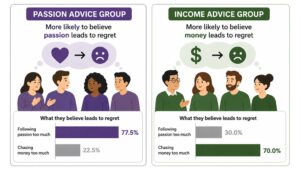
People strongly endorse passion, but they are cautious about it.
Looking at outcomes helps clarify things.
Those who prioritized passion reported higher career satisfaction and were more likely to say they would choose the same career again. They also reported higher satisfaction with their income.
That last finding is important. In this sample, prioritizing passion did not appear to reduce financial satisfaction.
There is still an interesting tension in the data.
Participants who wished they had followed their passion more also reported higher satisfaction across several areas. At the same time, many respondents expressed concern that too much emphasis on passion could lead to regret. Older participants were especially likely to hold that view.
This suggests that the issue is not a simple choice between passion and money.
A better way to think about it is that passion has benefits, but it also carries risk if it is pursued without attention to practical constraints.
Lower levels of passion are associated with less satisfaction and engagement. Very high levels of passion, without financial grounding, may create instability. The most favorable outcomes appear to occur when passion is combined with a realistic approach to earning a living.
A more complete version of the advice would be to follow your passion in a way that creates value for others and can be sustained financially.
One of the most interesting findings is the tension in people’s responses. They recommend passion, they wish they had leaned into it more, and at the same time they remain cautious about going too far.
That tension may reflect an underlying truth about careers. Satisfaction and financial success are both important, and they tend to come together when interests are developed in a way that is both meaningful and practical.
Finding that balance may be the real goal.