What does “financial success” really mean?
I recently ran a small study on OpenPublicPolls.com
(N = 50; mostly college-educated, full-time employed adults). The results challenged some common assumptions.
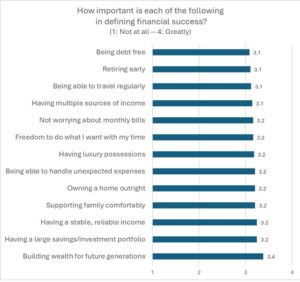
The highest-rated indicator of financial success wasn’t income or status—it was building wealth for future generations. Everything else clustered well below that.
In open-ended responses, people often used words like “freedom,” “security,” and “taking care of family.”
Looking deeper, I examined how people’s definitions of financial success are related to how financially successful they consider themselves.
Those who see themselves as financially successful were more likely to define success in terms of:
• Retiring early
• Being able to travel regularly
• Having multiple sources of income
• Building wealth for the future
• Owning a home outright
• Handling unexpected expenses
But here’s what wasn’t part of that definition:
• Having a stable, reliable income
• Not worrying about monthly bills
• Being debt free
Even more surprising, income itself showed little relationship to these definitions.
In other words, financial success may not be about stability or even income.
It’s about options:
The ability to choose how you spend your time.
The ability to absorb shocks.
The ability to build something that lasts beyond you.
Security matters—but it may not be what people use to define success.